Upper and Lower Blepharoplasty Recovery Timeline
What Your Eyes May Look and Feel Like as They Heal
One of the first questions patients ask about blepharoplasty is, “How long will I look like I had surgery?”
The answer depends on what is being treated. An upper blepharoplasty, a transconjunctival lower blepharoplasty and combined upper and lower eyelid surgery are different operations. They involve different layers of eyelid anatomy and do not always follow the same recovery timeline.

Swelling and bruising are generally most noticeable during the first several days. By the end of the first week, patients usually see a meaningful improvement, but they should not expect to look completely healed. Bruising may remain, the eyelids can still look puffy and one side may temporarily heal faster than the other.
By approximately two weeks, many of Dr. Richard Balikian’s patients feel comfortable returning to work or being seen socially. The eyes will continue changing after that. Residual swelling resolves, incisions soften and the eyelids gradually look more integrated with the surrounding face.
Dr. Balikian does not think of recovery as something that begins after surgery. Recovery is influenced by how the operation is planned, which structures are treated and which structures are preserved.
The eyelids contain several important layers. There is skin, the orbicularis oculi muscle that helps close the eyes and deeper fat compartments surrounding the eye.
Dr. Balikian’s approach is based on treating the layer responsible for the concern while avoiding unnecessary disruption of the other layers.
During upper blepharoplasty, an incision is placed where the eyelid skin naturally folds over itself. This allows the incision to remain concealed within the upper-eyelid crease as it heals.
Dr. Balikian removes the skin that is truly excessive while leaving enough skin for the eyes to close comfortably. He generally preserves the orbicularis muscle beneath the skin.
Some surgeons remove part of this muscle to expose more of the upper eyelid and create a dramatic early result. Dr. Balikian avoids doing that because removing muscle can contribute to hollowing and may create functional problems as the eyelids continue aging.
Upper-eyelid fat is also treated conservatively. Most of the natural fullness is preserved. If a localized pocket near the nose is protruding, a small amount may be removed to improve the contour without creating a skeletonized appearance.
These details affect both the long-term result and the way the eyelid heals.
Lower blepharoplasty is not simply an operation for removing bags. Dr. Balikian describes under-eye bags as shadows created by the relationship between a bulge and a trough.
The bulge comes from fat surrounding the eye. The trough is the hollow area beneath it. The greater the distance between the bulge and the trough, the larger the shadow appears.
The objective is to bring the bulge down and the trough up so the transition beneath the eye becomes smoother.
In most patients, Dr. Balikian accesses the lower-eyelid fat through a transconjunctival incision placed inside the eyelid. He does not need to make an incision through the external skin or cut through the orbicularis muscle to reach the fat.
This is important because the orbicularis muscle helps support the lower eyelid. Preserving it reduces disruption of the eyelid’s natural tone and helps protect against postoperative pulling or a change in eye shape.
The fat may be conservatively trimmed, repositioned into a hollow area or supplemented with small-volume fat transfer. When fat transfer is used, Dr. Balikian describes placing small droplets in multiple layers, like sprinkling seeds in a garden. The goal is not to place one large deposit that makes the area look full. It is to gently soften the shadow.
Lower-eyelid skin must be evaluated separately from the fat beneath it.
When true excess skin is present, Dr. Balikian may perform a conservative skin pinch. A small amount of skin is removed through an incision positioned immediately beneath the lash line. The underlying muscle is preserved.
Crepey skin is different from excess skin. Removing more skin does not necessarily improve fine lines or surface texture. It can create unnecessary tension on the lower eyelid.
When texture is the primary concern, laser resurfacing or a chemical peel may be more appropriate. Some patients need a skin pinch, some need resurfacing and some benefit from both.
Because these treatments heal differently, they can also change how long redness, swelling or surface sensitivity remains visible.

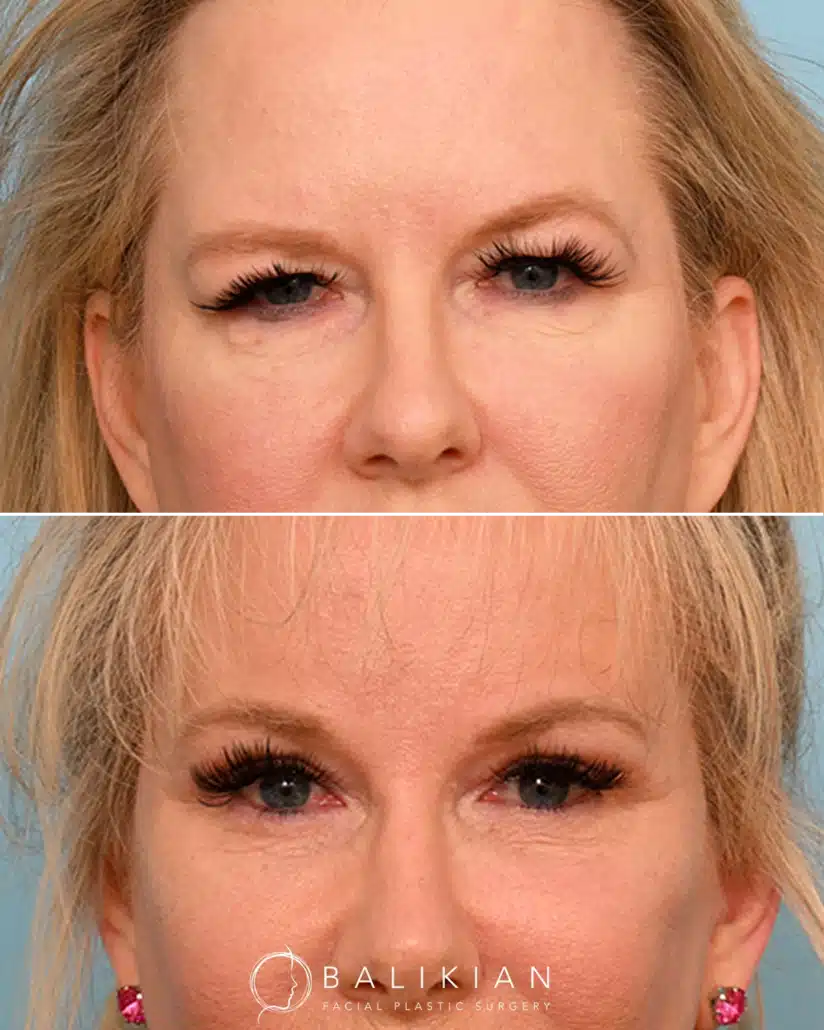
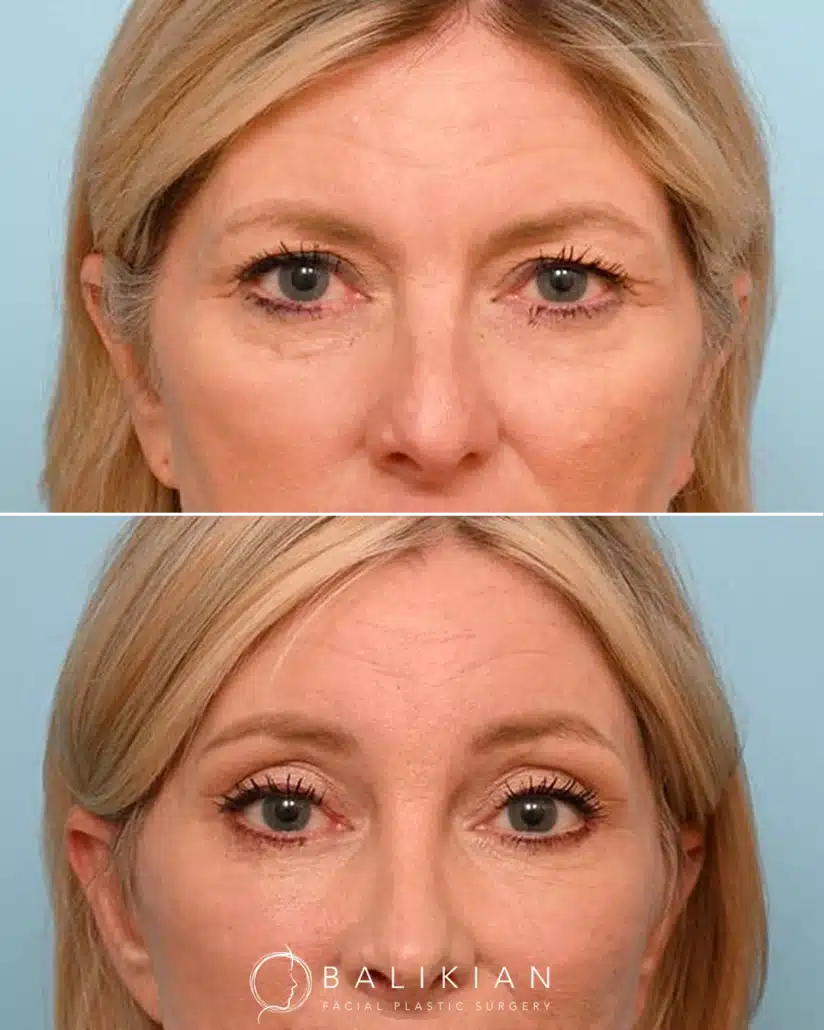
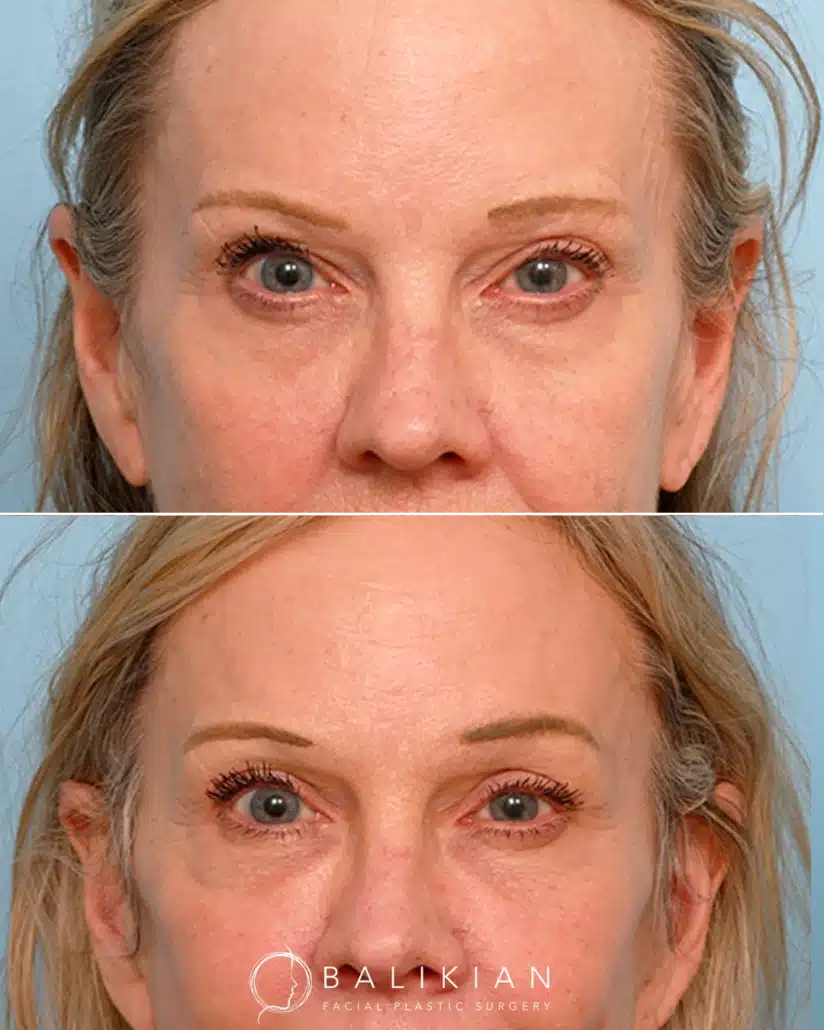
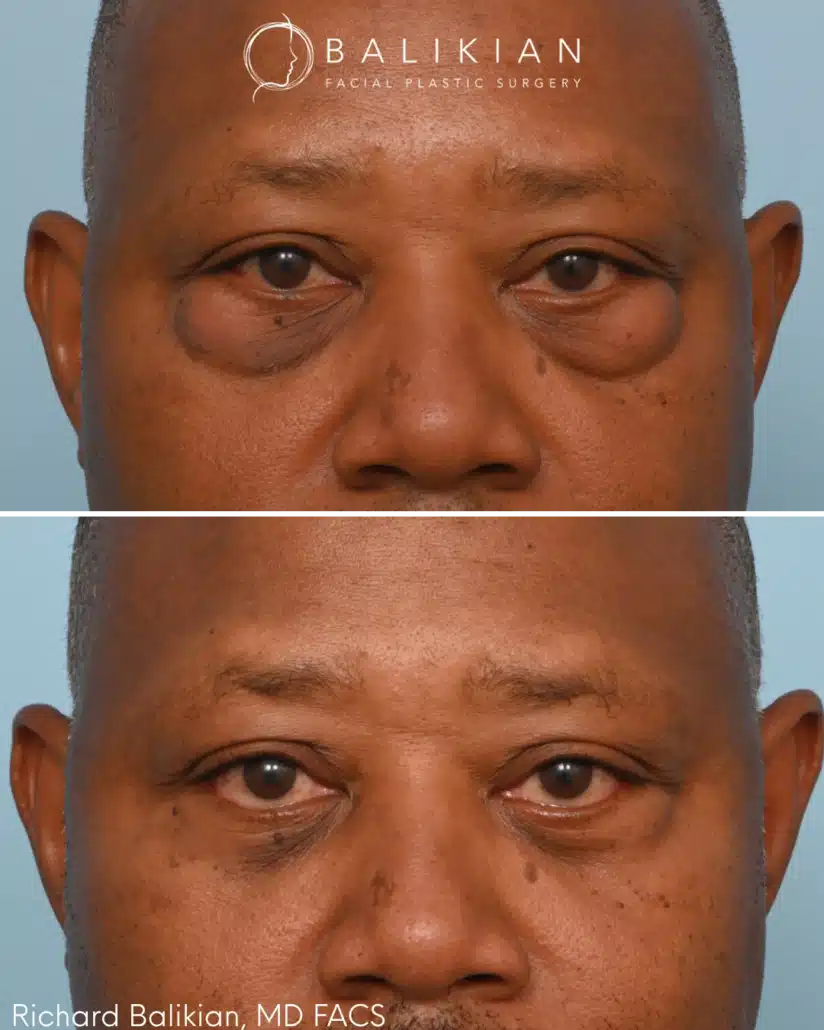
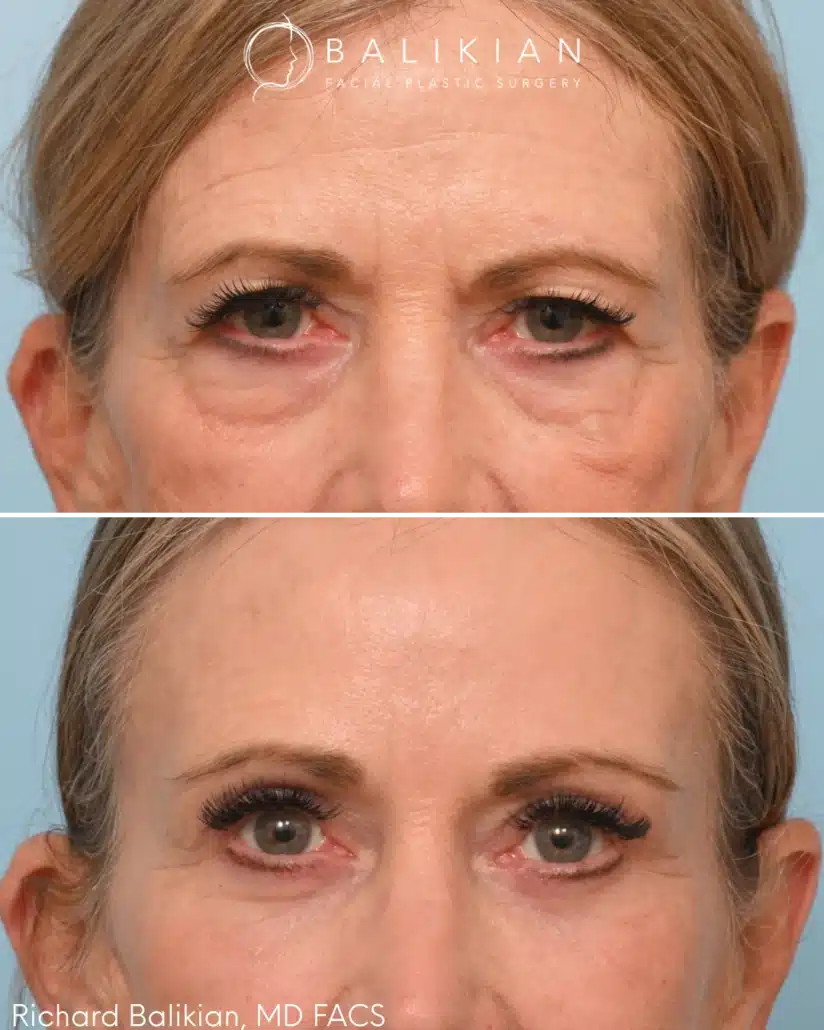
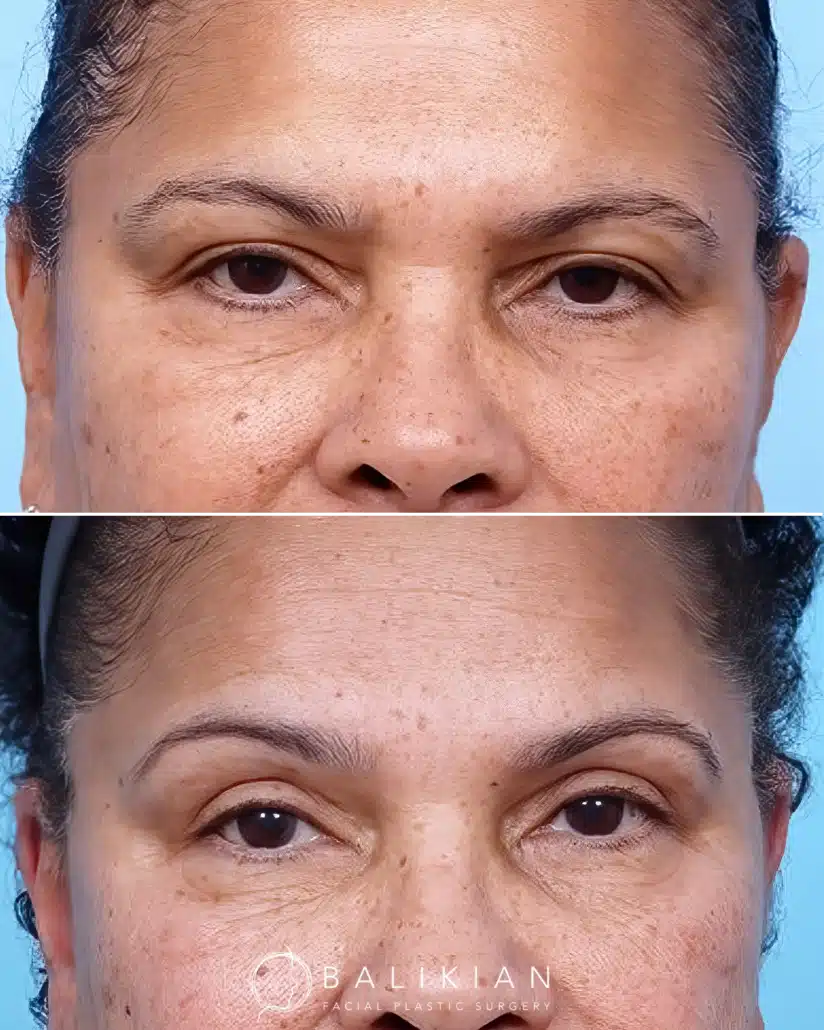

Every patient heals differently. The following timeline describes what patients commonly experience, but it is not a rigid schedule.
The first several days are generally the most noticeable part of blepharoplasty recovery.
Patients may experience:
Swelling and bruising do not always develop symmetrically. One eyelid may look more swollen even when both sides were treated similarly. This is common during early healing and usually becomes less noticeable as swelling resolves.
Patients should rest, keep their head elevated and use prescribed drops or ointment as directed. Bending, lifting, straining and strenuous exercise should be avoided.
Most patients describe the early experience as tightness or pressure rather than significant pain. Sudden or increasing pain is different and should be reported immediately.
During the second half of the first week, swelling usually begins softening and bruising starts changing color.
Dark bruising may become green or yellow before fading. The eyelids generally feel less tight, and reading or moderate screen use may become more comfortable.
Upper-eyelid sutures and any external sutures from a skin pinch are commonly removed during the first week, depending on how the incisions are healing.
The eyes will still look recently operated. Incisions can remain pink, the eyelids may look puffy and swelling is often more noticeable in the morning.
One week after eyelid surgery, most patients look noticeably better than they did during the first three days, but they should not expect to look completely healed.
At approximately one week, it is common to see:
Some patients feel comfortable running errands or working from home. Others prefer several more days before returning to public-facing activities.
The appearance at one week also depends on the procedure performed. Someone who undergoes upper blepharoplasty alone may look farther along than someone who undergoes upper and lower blepharoplasty with fat transfer, a skin pinch or laser resurfacing.
A one-week photograph should never be viewed as a final result. The eyelids are still swollen, incision lines are immature and the transition beneath the eyes has not fully settled.
The second week is when many patients begin feeling comfortable returning to work and social activities.
Bruising is generally much lighter and can often be concealed with makeup after the incisions have sealed and Dr. Balikian has provided clearance. Swelling continues to improve, and the eyes begin looking more open and rested.
Patients may still notice:
Lower-eyelid swelling can remain longer than upper-eyelid swelling. This is especially true when fat repositioning or fat transfer has been used to improve the lid-cheek transition.
Returning to work in approximately two weeks does not mean healing is complete. It means the most visible stage has generally passed and the remaining changes are becoming less apparent to other people.
By three to four weeks, most obvious bruising has resolved. Incision lines continue softening and the eyelids begin looking more natural.
Patients often notice that:
Small changes continue from week to week. Patients who had lower-eyelid fat transfer, resurfacing or surgery combined with a facelift may still have more visible swelling than someone who underwent isolated eyelid surgery.
By two to three months, most swelling has resolved and the eyelids begin feeling more fully integrated with the face.
Upper-eyelid incision lines become softer and less noticeable within the natural crease. Lower-eyelid shadows continue improving as swelling settles and the relationship between the fat pockets, trough and cheek becomes clearer.
Patients may still notice temporary firmness, numbness or subtle differences between the two sides. These changes usually become less apparent as healing continues.
Blepharoplasty does not have one specific day when the result suddenly becomes final.
The majority of the visible improvement occurs much earlier, but incision maturation can continue for six months to a year. Upper-eyelid scars gradually fade within the natural crease. A skin-pinch incision heals close to the lash line. A transconjunctival lower blepharoplasty does not create an external skin scar.
Natural aging continues after surgery. The goal is not to create eyes that never age. It is to restore a brighter, more rested appearance while preserving the shape, fullness and expression that make the eyes look like the patient’s own.
Dr. Balikian’s short-video series provides a closer look at how upper and lower blepharoplasty are planned and performed. The videos explain eyelid anatomy, fat preservation, under-eye bags, brow position and the surgical decisions that help preserve natural eye shape.



Real surgical case reviews also demonstrate why recovery is different for every patient. The procedures selected depend on whether the concern comes from excess skin, brow descent, fat pockets, hollowing, skin texture or a combination of these changes.
Some of the main things patients want to know about blepharoplasty recovery are when they can return to work, wear makeup and contact lenses, resume exercise and expect their eyes to feel normal again. These milestones do not occur on exactly the same day for every patient. The timeline depends on whether the upper eyelids, lower eyelids or both were treated, as well as the techniques included in the surgical plan.
Dr. Balikian evaluates each patient’s healing before clearing specific activities. The following guidance provides a general overview of what patients may expect.
Patients who undergo upper blepharoplasty alone may feel capable of working sooner, particularly when working from home. Dr. Balikian generally tells patients to expect approximately two weeks before feeling comfortable returning to work and social activities.
The actual timeline depends on:
Patients with strenuous jobs may need more time than those returning to desk work.
Makeup must be delayed until the incisions have sealed and any external sutures have been removed. Dr. Balikian will provide clearance based on how the eyelids are healing.
When makeup is resumed:
Makeup can help conceal residual bruising, but it should not be used before the skin is ready.
Contact lenses are generally avoided during early recovery because swelling, ointment and temporary dryness can make them uncomfortable. Glasses should be used until Dr. Balikian confirms that contact lenses can be worn safely.
Patients with preexisting dry eye, previous eye surgery or difficulty tolerating contact lenses should discuss those issues during the consultation.
Gentle walking is encouraged early, but strenuous exercise, heavy lifting and bending can increase blood pressure and prolong swelling.
Patients should wait for clearance before resuming:
Returning to these activities gradually and only after clearance helps protect the healing eyelids and reduce the risk of increased swelling or irritation.
Temporary dryness, tearing, light sensitivity and blurry vision from ointment can occur during early recovery.
Dr. Balikian evaluates eye comfort and eyelid function before surgery because the ability to close and protect the eyes is part of a safe upper blepharoplasty. This is one reason he removes the appropriate amount of skin rather than attempting to expose as much eyelid as possible.
Prescribed drops and ointment help protect the eye surface while swelling resolves.
Patients should contact the office for symptoms that worsen rather than improve, particularly severe pain, increasing pressure or a sudden change in vision.
Upper-blepharoplasty incisions are placed where the skin naturally folds. Early in recovery, the incision may look pink, slightly raised or more visible than expected. It gradually flattens and fades as the scar matures.
A lower-eyelid skin-pinch incision is positioned immediately beneath the lashes. Transconjunctival lower blepharoplasty is performed through the inside of the eyelid and leaves no external incision.
Patients should protect healing incisions from the sun and avoid applying scar products or massaging the eyelids unless instructed to do so.
Some swelling, bruising, tightness and temporary visual blurring from ointment are expected.
Contact Dr. Balikian’s office immediately for:
Serious complications are uncommon, but changes involving pain, pressure or vision require prompt evaluation.
A natural result does not begin with deciding how much skin or fat to remove. It begins with determining what is causing the eyes to look heavy or tired.
Upper-eyelid heaviness may come from excess skin, brow descent, localized fat or a combination of these changes. Under-eye shadows may come from protruding fat, a hollow trough, volume loss through the cheek, excess skin or surface texture.
Dr. Balikian evaluates these structures together and creates a surgical plan specific to the patient. He removes what is truly excessive, preserves the muscles and natural fullness that support the eyelids, and treats the contour relationships responsible for shadows.
That same planning influences recovery. When the correct layer is treated and the surrounding anatomy is respected, the objective is not merely a shorter recovery. It is a result that continues to look natural, balanced and functional as the patient ages.
How long does blepharoplasty recovery usually take?
Most patients feel through the “intense” part of recovery within 10 to 14 days, when bruising and most swelling have improved. Fine swelling and incision maturation continue for 2 to 3 months, which is when results look their most natural. Clinical studies of upper eyelid blepharoplasty show that edema and bruising peak in the first few days and steadily decline over the first week.
When will I start to look more refreshed after eyelid surgery?
You begin to see a more rested look once the early swelling settles, usually around the end of the first week. Many patients feel “public ready” by 10 to 14 days, with ongoing refinement in lid contour, crease definition, and under-eye smoothness over the next several weeks.
Does upper eyelid blepharoplasty heal faster than lower eyelid surgery?
Yes. Upper eyelid blepharoplasty alone typically has a shorter and easier recovery than lower lid or combined upper and lower surgery. Published series show very low complication rates and rapid return to daily activity with isolated upper blepharoplasty compared with more complex lower lid procedures.
How much bruising and swelling should I expect, and how can I reduce it?
Bruising and swelling are most noticeable in the first 3 to 5 days, then fade over 7 to 10 days. Studies show that standard postoperative care, including cold compresses and elevation, reduces the intensity and duration of edema and ecchymosis after upper eyelid surgery. Light-based treatments, which Dr. Balikian offers, may also support faster recovery by calming inflammation.
Is blepharoplasty recovery very painful?
Most patients describe eyelid surgery as tight, sore, or “pressure like” rather than intensely painful. Large outcome series report high satisfaction and low rates of significant postoperative pain when modern techniques and careful tissue handling are used. Oral medication and cold compresses are usually enough to keep you comfortable.
Will I have dry eyes or blurry vision after surgery?
Temporary dryness, tearing, or mild blur is common in the early healing period. Prospective studies of cosmetic blepharoplasty show short term changes in tear film and ocular surface that typically improve by 1 to 3 months with lubricating drops and proper care. Longer term data suggest that most patients return to their preoperative comfort level once healing is complete.
When can I wear makeup or contact lenses again?
Most patients can resume eye makeup once the skin incisions have sealed and surface stitches are removed, often around 7 to 10 days, as long as there is no irritation. Contact lenses are usually delayed a little longer, often 2 weeks or more, to protect the cornea while swelling resolves. These timelines match common postoperative protocols reported in oculoplastic literature, but Dr. Balikian will give you a personalized clearance based on how you heal.
When is it safe to exercise after blepharoplasty?
Light walking starts early, often within a few days. Most surgeons, including Dr. Balikian, recommend avoiding strenuous exercise, heavy lifting, or activities that raise blood pressure for about 2 weeks to lower the risk of bleeding and prolonged swelling. This approach aligns with published guidelines that link reduced early physical strain to fewer postoperative complications.
What is the recovery like after transconjunctival lower blepharoplasty?
With a transconjunctival incision inside the lower lid, there is no external scar and less disruption of eyelid support structures. Studies of transconjunctival lower blepharoplasty show low rates of lid retraction and fast resolution of swelling and bruising, which supports quicker cosmetic recovery in appropriately selected patients.
How long will my blepharoplasty results last once I am healed?
Upper and lower eyelid surgery results often last for many years. Long term follow up studies report durable improvement in lid position, reduced puffiness, and high patient satisfaction even 5 to 10 years after surgery, although natural aging continues. When fat is repositioned rather than removed, results tend to age more gracefully and avoid the hollow look associated with older techniques.
What are warning signs during recovery that should prompt a call to the office?
You should contact the office immediately for sudden vision changes, severe or increasing pain, significant fresh bleeding, rapidly growing swelling, or marked redness. These can be signs of rare but serious issues such as orbital hemorrhage or infection. Reviews of blepharoplasty complications emphasize that early recognition and treatment are critical for protecting vision and final cosmetic outcome.
What can I do to support the best possible recovery and result?
Following instructions closely is one of the most important factors in how you heal. Evidence from eyelid and facial surgery shows that not smoking, managing medical conditions, pausing blood thinning medications when appropriate, and protecting the eyes during healing all contribute to smoother recovery and fewer complications. Dr. Balikian’s protocol adds light therapy, precise incision care, and structured follow up to help your lids recover safely and predictably.
Dr. Richard Balikian is a highly respected facial plastic surgeon serving the San Diego area.
With over 20 years of experience and double board certification in Facial Plastic and Reconstructive Surgery as well as Head and Neck Surgery, Dr. Balikian offers a unique combination of technical expertise and artistic vision.
He is part of an elite group of surgeons with extensive training focused exclusively on the face and neck.